---
title: Domains Overview
description: The Domains feature provides a streamlined way to monitor and manage all your connected domains’ performance and health in one place. It gives you quick access to essential metrics, allowing you to identify issues and track improvements effortlessly.
---
[Skip to content](https://support.warmy.io/knowledge/domains#main-content)
English
Show submenu for translations
![Group 1261151152.png\]](https://support.warmy.io/hs-fs/hubfs/Group%201261151152.png?width=50&height=50&name=Group%201261151152.png)
Open main navigation
Close main navigation
- English
Show submenu for translations
- [Go to warmy.io](https://www.warmy.io/)
[Go to warmy.io](https://www.warmy.io/)
Hey there Warmer! How can we help? 🙏
- There are no suggestions because the search field is empty.
1. [Help Center](https://support.warmy.io/knowledge?hsLang=en)
2. [General questions](https://support.warmy.io/knowledge/general-questions?hsLang=en)
# Domains Overview
## Learn how to track your domain health, monitor key deliverability metrics, and replace an old domain with a new one when needed.
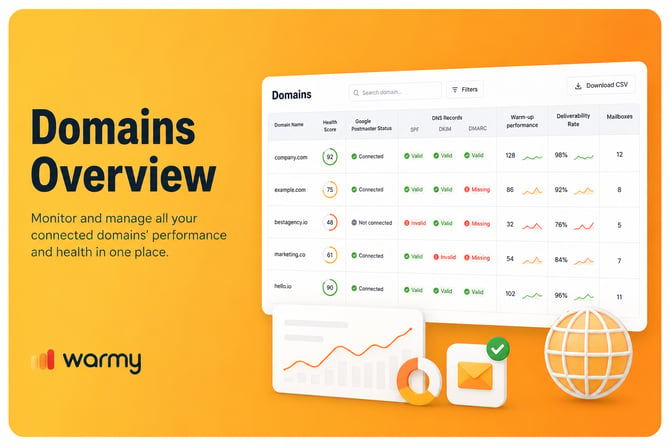
**👀 Please take a look in the video with the steps if you need any help 😎**
---
🎧 Prefer to listen? Hit play to hear this article read aloud.
The Domains page gives you a complete overview of every domain connected to your Warmy account. Think of it as your command center for domain health; you can see at a glance which domains are performing well and which ones need attention.
This page shows you important metrics like health scores, DNS record status, and deliverability rates. You can also export your data or click into any domain for a more detailed view.
By the end of this guide, you'll know how to monitor your domains and how to switch from an old domain to a new one if needed.
---
**How to Access the Domains Page?**
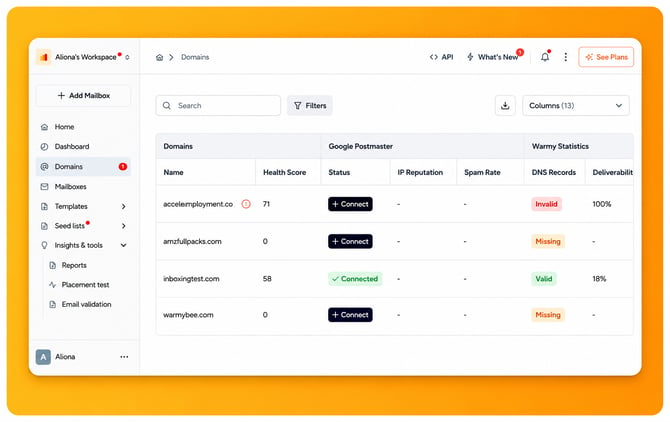
Your domains automatically appear in Warmy once you connect mailboxes under them. There's no separate "Add Domain" button; just connect a mailbox and the domain shows up here.
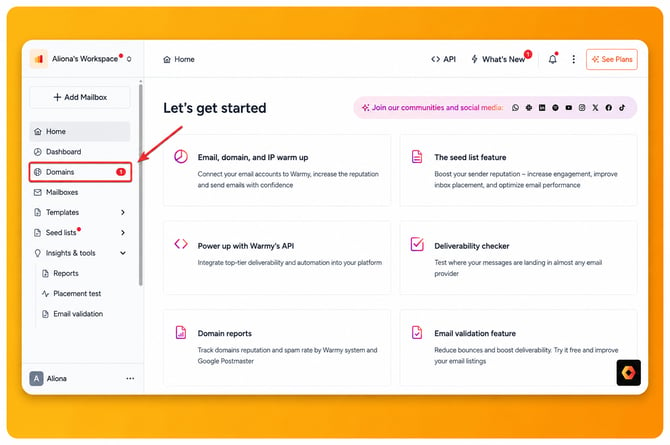
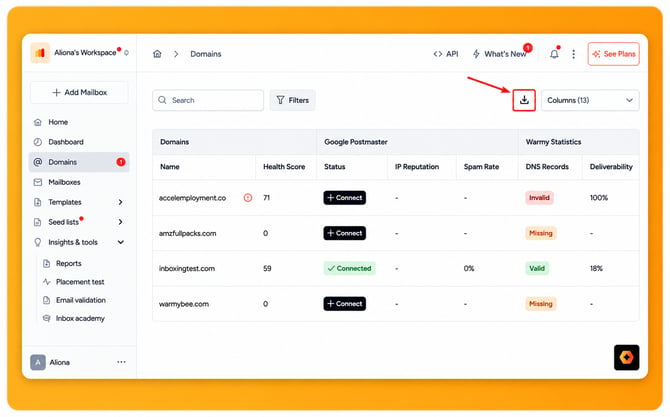
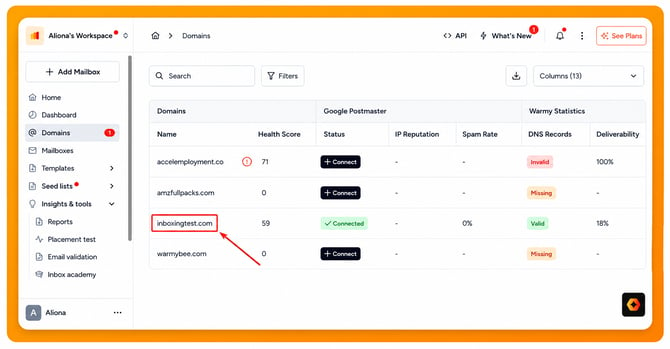
From your Warmy dashboard, click on the **Domains** tab in the left-hand menu. You'll see a table listing all your connected domains.
---
**Understanding Your Domain Metrics**
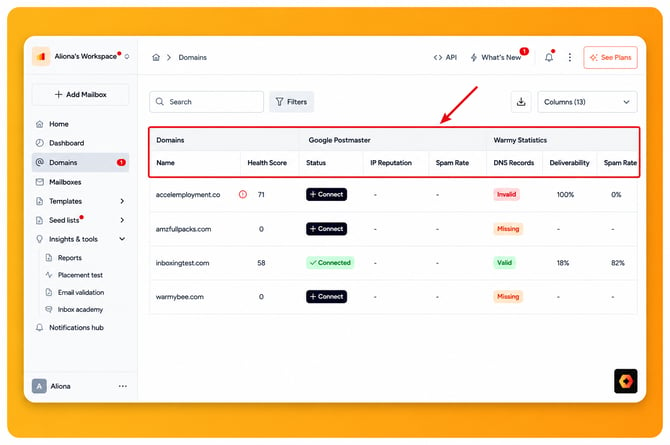
The Domains table shows you several key metrics for each domain. Here's what each one means:
• **Domain Name**
This is the name of each connected domain, like yourcompany.com.
• **Health Score**
A quick numerical rating from 0 to 100 that summarizes your domain's overall health. Higher scores mean better health.
• **Google Postmaster Status**
Shows whether your domain is connected to Google Postmaster Tools. This connection helps you monitor how Google views your email reputation.
**• DNS Records**
Displays the status of your SPF, DKIM, DMARC, and other DNS records. You'll see one of three statuses:
• Valid: Everything is set up correctly.
• Invalid: There's an issue with the record.
• Missing: The record hasn't been set up.
**What are DNS records?**
These are like digital ID cards that tell email providers your emails are legitimate. SPF, DKIM, and DMARC help prevent spammers from pretending to be you.
**• Warm-up Performance**
The number of warm-up emails successfully delivered through our network. This shows how well your warm-up process is working.
**• Deliverability Rate**
The percentage of test emails that actually land in the inbox (not spam). This reflects your real-world sending performance.
**• Mailboxes**
The total number of mailboxes connected under each domain.
---
**How to Search and Export Domain Data?**
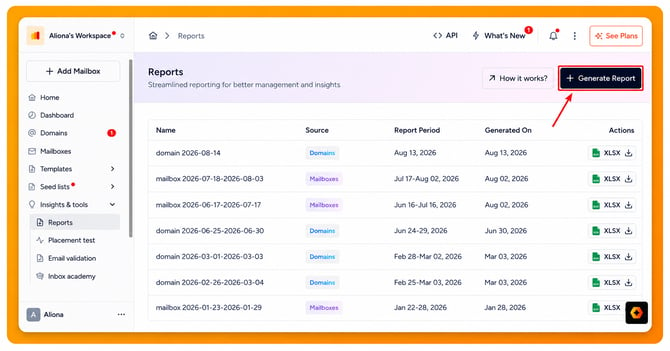
Click on the **download icon**, then click on the **Generate Report** button.
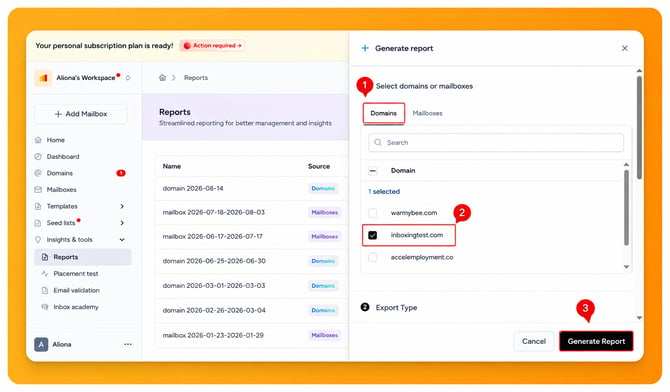
Next, a window will open in the upper right corner. Select **Domains** and use the search bar to find the domain you want. Check the checkbox to select the domain and click on the **Generate Report** button.
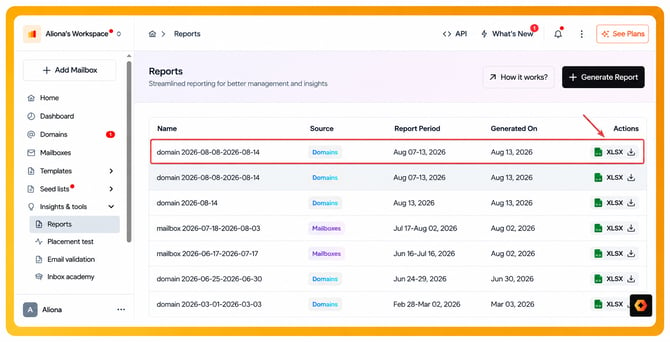
Once the report is generated, you will see it at the beginning of the reports section.
On the right side, you can observe the **XLSX button** with the download icon.
Clicking that button will download your report in **.xlxs format** so you can open it with your favorite spreadsheet application.
---
**How to View a Domain Dashboard?**
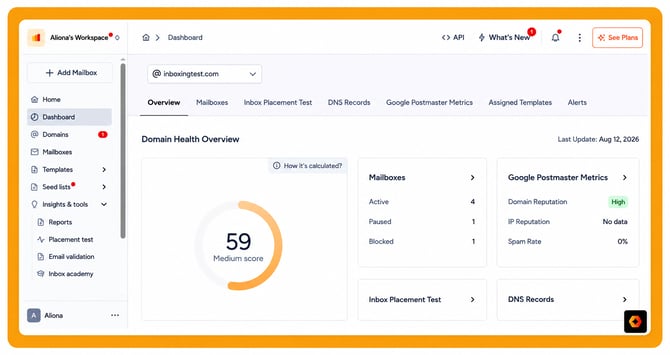
Click on any domain name in the table. This takes you to a detailed dashboard for that specific domain, where you can troubleshoot issues and dive deeper into its performance.
**Why use the Domains page?**
• Efficiency: Monitor all your connected domains at a glance.
• Proactive Management: Quickly identify domains needing attention and address issues before they escalate.
• Actionable Insights: Gain a clear understanding of each domain’s performance with key metrics.
• Data Flexibility: Export domain data to CSV for offline analysis or reporting.
---
**How to Add a Domain to Your Workspace?**
Adding a domain starts with connecting a mailbox; no separate **"Add Domain"** button exists.
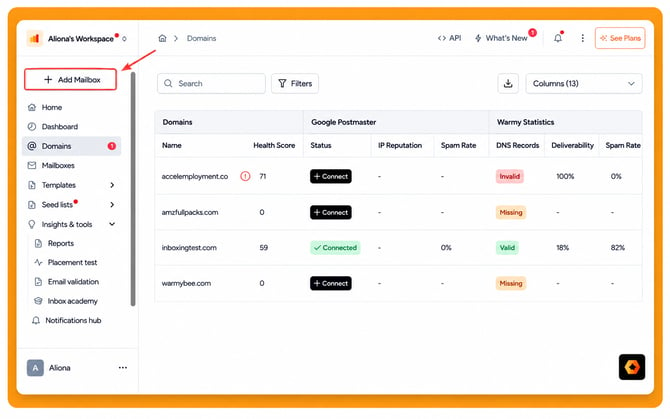
1\. On the **Domains** page, click the **Add Mailbox** button.
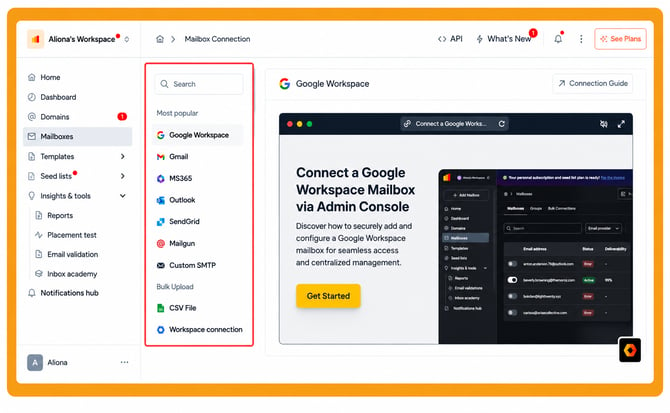
2\. Select your email provider and follow the steps to connect your new email account.
3\. The new domain will automatically appear in your Domains list.
---
**How to Change or Replace Your Connected Domain?**
If you need to switch from an old domain to a new one, here's the process to follow.
**Important Before You Start**
Replacing a domain involves removing mailboxes connected to the old domain and adding new ones. Removing mailboxes **will stop warm-up** for those email addresses, so plan accordingly.
**Access Your Mailbox List**
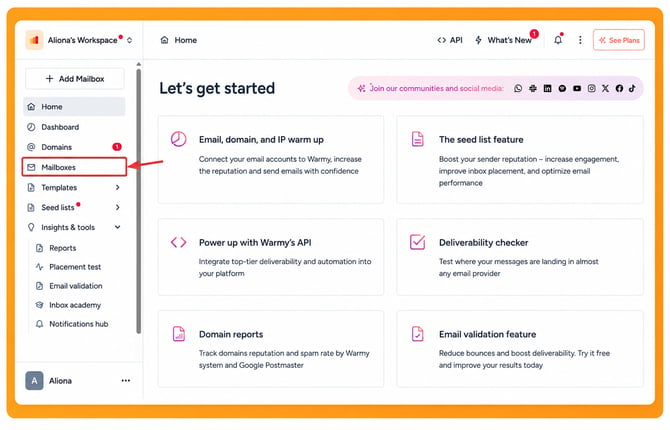
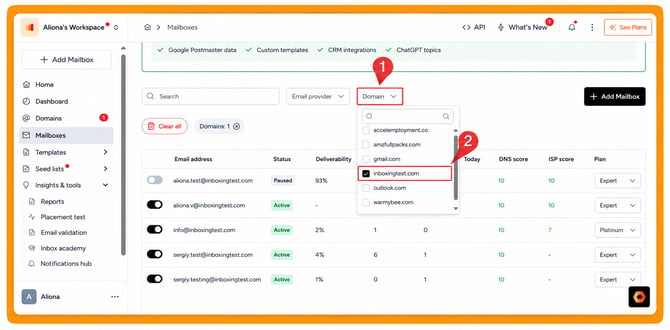
1\. From your Warmy dashboard, go to the **Mailboxes** section.
2\. Locate all mailboxes that belong to the domain you want to remove.
### 
**Remove Mailboxes from the Old Domain**
For each mailbox connected to the old domain:
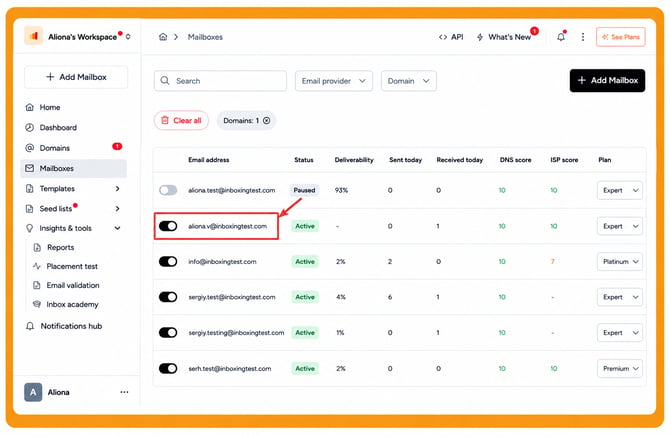
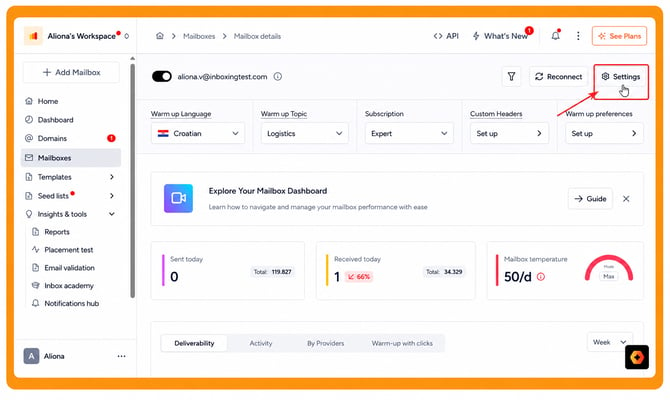
1\. Click on the mailbox to open its settings.
2\. Look for the option **Settings**, click on it, and click on **Want to disconnect your mailbox?** to delete or remove the mailbox.
3\. Confirm the removal when prompted.
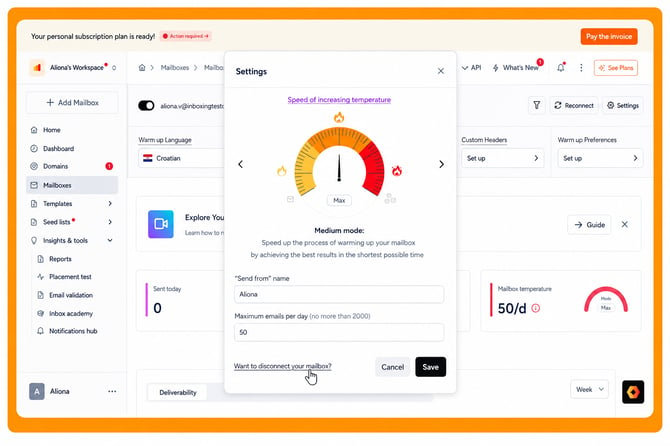
**Note:** Removing a mailbox stops its warmup activities and removes it from the domain. Make sure you're ready to make this change before proceeding.
**Add Mailboxes for the New Domain**
1\. On the **Domains** option, click the **Add Mailbox** button.
2\. Follow the steps to connect your new email account.
3\. The new domain will automatically appear in your Domains list.


---
**A Seamless Experience for Better Domain Management**
The **Domains** and **Dashboard pages** simplify the complex task of domain monitoring and management, making it accessible to all users. With key metrics available at a glance and tools for deeper analysis, you can ensure your domains perform at their best. Start using the Domains feature today and take control of your email deliverability!
#### [Need help? **Schedule a call with us**](https://www.warmy.io/book-a-support-call)
- [Connection Guide](https://support.warmy.io/knowledge/connection-guide?hsLang=en)
- [General questions](https://support.warmy.io/knowledge/general-questions?hsLang=en)
- [Technical questions](https://support.warmy.io/knowledge/technical-questions?hsLang=en#main-content)
- [SPF and DKIM Configuration](https://support.warmy.io/knowledge/technical-questions?hsLang=en#spf-and-dkim-configuration)
- [Subscription](https://support.warmy.io/knowledge/subscription?hsLang=en)
- [Collaborate](https://support.warmy.io/knowledge/collaborate?hsLang=en)
- [Features](https://support.warmy.io/knowledge/features?hsLang=en)
- [Troubleshooting](https://support.warmy.io/knowledge/troubleshooting?hsLang=en#main-content)
- [SMTP Errors](https://support.warmy.io/knowledge/troubleshooting?hsLang=en#smtp-errors)
- [Service-related issues](https://support.warmy.io/knowledge/troubleshooting?hsLang=en#service-related-issues)
- [Integrations](https://support.warmy.io/knowledge/integrations?hsLang=en#main-content)
- [Seed List Automations](https://support.warmy.io/knowledge/integrations?hsLang=en#seed-list-automations)
[](https://www.warmy.io/)
warmy.io Help Center
Copyright © 2026, AnyBiz LTD