![Group 1261151152.png]](https://support.warmy.io/hs-fs/hubfs/Group%201261151152.png?width=50&height=50&name=Group%201261151152.png)
🎧 Prefer to listen? Hit play to hear this article read aloud.
Introduction
Email deliverability depends on more than just the content of your message. Your sending infrastructure and email authentication settings also play an important role in determining whether your emails reach the inbox or end up in spam.
Before sending emails, make sure your domain, IP address, and email authentication settings are properly configured.
Here are the main technical parameters you should check.
Technical Parameters to Check:
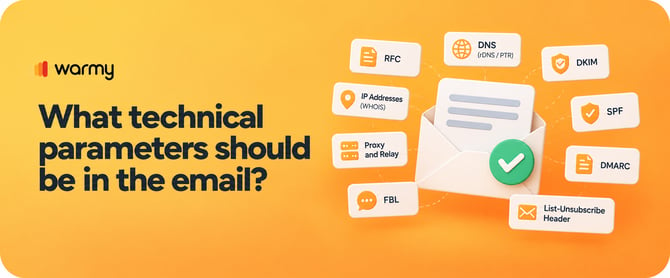
✅ DNS (rDNS and PTR records) Domain Name System - all servers from which the mailing is being sent must have valid DNS records.
✅ IP Addresses (WHOIS) You cannot hide IP address data in WHOIS. Hosters can be hacked and send spam on behalf of your IP.
✅ Proxy and Relay are protection against sending spam on your behalf. The server must not be with an open Proxy or open Relay.
✅ DKIM (DomainKeys Identified Mail) - a protocol for digitally signing a letter that determines whether the sender has the right to send mail. The mail provider identifies it through a special key.
✅ SPF (Sender Policy Framework) - a record that will show from which domains and/or IP mail will come. This setting must be in all DNS, otherwise, the mail service will send the letter to spam or warn about the threat.
✅ FBL (FeedBack Lookup) - Shows all information about spam complaints. If you have it configured, you will be able to see exactly who marked your email as spam.
✅ List-Unsubscribe Header is an additional ‘unsubscribe’ link generated by some of the most common email providers (Gmail, Outlook, etc.) when list-unsubscribe instructions are detected in the email header. It gives email recipients the opportunity to remove their email addresses from your distribution list without searching for the unsubscribe link in your email.
✅ Domain-based Message Authentication, Reporting & Conformance (DMARC) is an email sender authentication policy based on the DKIM and SPF protocols. This policy determines how the recipient's mail server should process incoming messages if the sender's address could not be identified.